
Last year, an international team of scientists mapping the underground landscape surrounding Stonehenge announced that they had located a massive stone monument that dwarfed its ancient neighbor. When archaeologists started excavating “Superhenge” earlier this month, however, they found something completely different.
In September 2015, scientists announced that the English countryside two miles northeast of Stonehenge concealed an enormous secret—a massive stone monument possibly five times bigger than the iconic landmark. An international team of researchers with the Stonehenge Hidden Landscape Project said the strong signals detected by their ground-penetrating radar and GPS-guided magnetometers led them to believe that they had found a “Superhenge” with more than 100 stone monoliths buried beneath Durrington Walls, once home to a Neolithic settlement thought to have been occupied by Stonehenge’s builders
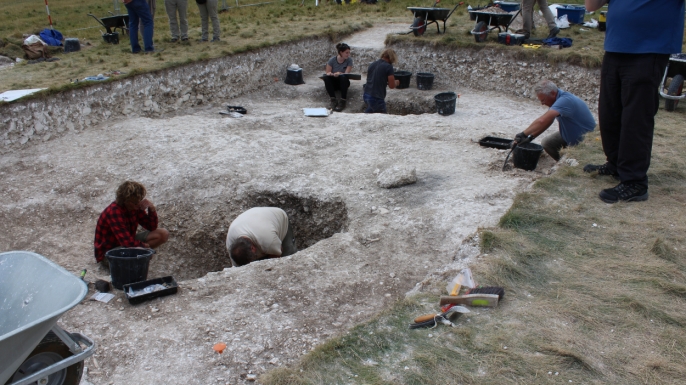
When archaeologists began to excavate the Superhenge site earlier this month, however, they discovered a big surprise. The anomalies that had been detected in the geophysical survey turned out not to be a series of buried stones lying on their sides but a collection of five-foot-deep pits deliberately filled with blocks of chalk that once housed soaring wooden timbers. The archaeologists found ramps at the sides of the pits that were used by the ancient people to lower the poles into place. The two-week dig also unearthed tools used by the Neolithic builders such as a spade made from a cow’s shoulder blade.

“We found voids filled with infill material showing where the posts had stood and also marks on the chalk, part of the natural geology on the site, at the base of the post holes that showed where they had been twisted in order to loosen them when they were removed,” says Dr. Nick Snashall, an archaeologist with Britain’s National Trust who is responsible for the Stonehenge site.
The research team believes the massive wooden poles, upwards of 20 feet tall, may have been part of a great circular timber monument likely built 4,500 years ago in the Late Neolithic period to memorialize Stonehenge’s builders immediately after they abandoned the Durrington Walls settlement after a decade of use. As the vast ring neared completion after months—possibly years—of construction, it appears that the ancient pagans suddenly stopped work and removed the timbers due to a sudden religious or political change. The Independent newspaper reports that the abandonment of the project could have been tied to the arrival around this time of a new people or traditions known as the Beaker culture.

It appears that the massive timbers were lifted vertically straight out of their holes, not rocked or pulled over before their removal. The pagans then replaced the wooden monument with an enormous circular bank of dirt stretching around a mile-long circumference that can still be seen today.
The Neolithic people who built Stonehenge were also known to use timber at times to erect structures such as Woodhenge, a circular pattern of 168 timber posts adjacent to Durrington Walls that resembled Stonehenge. What was the meaning of the two materials to the ancient pagans? “The significance of wood versus stone at this time is a matter of much debate among archaeologists,” Snashall tells HISTORY. “One of our project leads, Professor Mike Parker Pearson, is of the view that wood is connected with the living and stone with the dead or ancestors. That would make sense in this context as immediately before the putting up of the timber posts this site had been an enormous settlement—the evidence suggests for the builders of Stonehenge.
“Of course individual timber posts may have been carved or painted and served as totem poles or told the stories of individuals, ancestors or gods. The careful removal of these posts may have been to enable their use in another monument nearby and/or because of the significance of individual posts.”
Source http://www.history.com/news/superhenge-excavation-reveals-big-surprise


