
New analysis reveals likely impact of global warming on plants and animals if we fail to take action, and comes ahead of crunch climate talks in Paris
In pictures: Animals and plants that could be lost because of climate changehttp://www.theguardian.com/environment/gallery/2015/apr/30/animals-and-plants-that-could-be-lost-because-of-climate-change-in-pictures
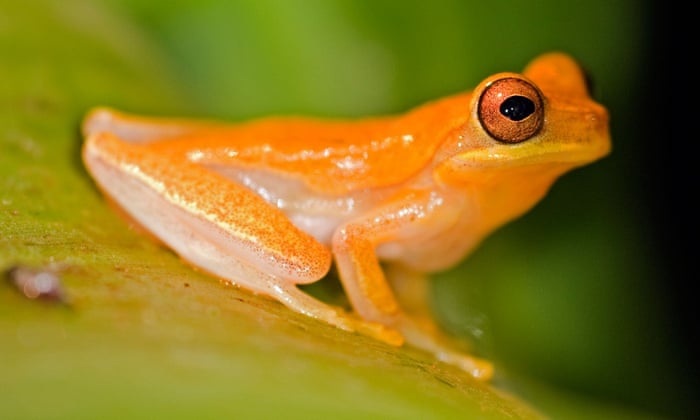
The golden toad was once native to the cloud forests of Costa Rica, but climate change aggravated the threats from deadly chytrid fungus and pollution, eventually driving the species to extinction. Photograph: Alamy
One in six of the planet’s species will be lost forever to extinction if world leaders fail to take action on climate change, according to a new analysis.
The stark warning on the scale of global warming’s impact on animals and plants comes just months before nearly 200 governments meet for UN climate talks in Paris in an attempt to forge a global deal on cutting carbon emissions.
Conservationists said such a large loss would be a tragedy with serious ramifications for people as well as ecosystems.
Creatures in Australia, New Zealand and South America will be hit much harder than North American and Europe, due to a high number of species not found anywhere else, such as Australia’s white lemuroid ringtail possums, which can die within hours in higher temperatures.
Relatively small land masses in Australia and New Zealand mean that many species there will be unable to migrate to cope with rising temperatures, found the study, published in the journal Science on Thursday.
The study is the most comprehensive look yet at the impact of climate change on biodiversity loss, analysing 131 existing studies on the subject. The stresses on wildlife and their habitats from global warming is in addition to pressures such as deforestation, pollution and overfishing that have already seen the world lose half its animals in the past 40 years.
“The risk if we continue on our current trajectory is very high. If you look out your window and count six species and think that one of those will potentially disappear, that’s quite profound,” said the study’s author, Mark C Urban, of the University of Connecticut.
“Those losses would affect our economy, our cultures, our food security, our health. It really compels us to act.”
Any deal that emerges from the UN climate summit in Paris is not expected to initially be enough to hold warming to 2C, the ‘safe’ level of warming world leaders are committed to, though the hope is governments’ carbon-cutting pledges will later be strengthened sufficiently to meet it.
But even if governments do manage to hold global warming to 2C, one in 20 species (5.2%) still face extinction, the study found.
If manmade greenhouse gas emissions continue at their current record-breaking rate, leading to a temperature rise of more than 4C by the end of the century, 16% of species, or one in six, face extinction.
The study also emphasises that even for the animals and plants that avoid extinction, climate change could bring about substantial changes in their numbers and distribution.
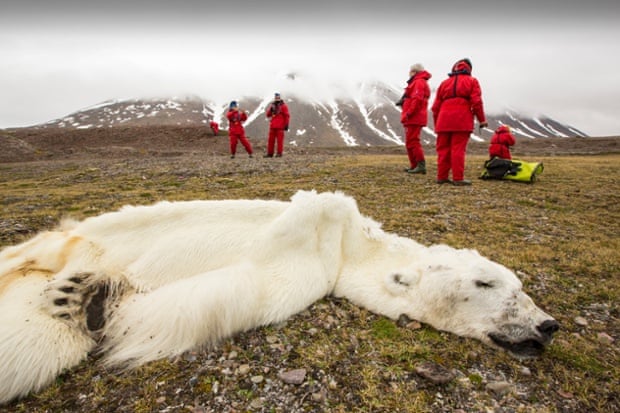
A male polar bear ( Ursus maritimus) starved to death as a consequence of climate change. Photograph: Ashley Cooper/globalwarmingimages.net
Jamie Carr at the climate unit of the International Union for Conservation of Nature, which compiles the most authoritative list of endangered species worldwide, said: “The loss of one in six species, would be an absolute tragedy, not only because it is sad to lose any part of our rich natural world, but also because biodiversity is fundamental in providing important functions and services, including to humans.
“Such significant changes to biological systems would undoubtedly have knock-on effects, and could potentially result in the collapse of entire systems.”
Richard Walters, lecturer in ecology and evolutionary biology at the University of Reading, said: “Ecologists have attempted to predict the risk of extinction under climate change for some time now but this meta-analysis provides our most comprehensive guesstimate to date.
“We know that the accuracy of forecasts are dependent upon a whole suite of assumptions, but what this study helps us to identify is which are the most important unknowns.”
Climate change affects wildlife directly and indirectly, through changing weather patterns that may affect the food they rely on or the habitat they live in. Species in the Arctic are considered particularly vulnerable, with polar bears being forced to swim further distances for food as sea ice melts to record lows. Ringed seals depend on the sea ice, which they rest on and mate below.
But the slow-motion rate at which some of the predicted extinctions will happen means that targeted conservation efforts for some at-risk species could help them survive a warmer world – while other species may be able to adapt in time.
“This isn’t just doom and gloom. We still have time. Extinctions can take a long time. There are processes that could be important in mediating these effects, for example evolution, but we really need to very quickly start to understand these risks in a much more sophisticated way,” said Urban.
His meta-analysis looked at 131 previously published studies on warming’s impact on wildlife, dating back to the early 1990s, most of which modelled how much habitat becomes unsuitable for species under future climates.
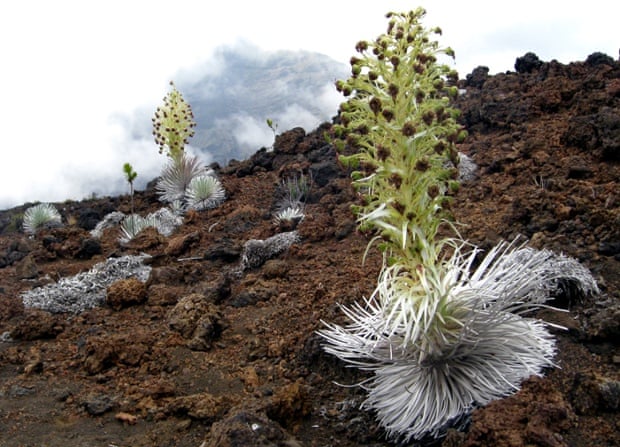
Haleakalā silversword plants line the edge of Haleakala’s volcanic crater in Maui, Hawaii. Photograph: Jens Grosser/NG/Corbis
For example, the Haleakalā silversword, a striking-looking plant that is only found on the Hawaiian island of Maui, was saved by conservationists from overzealous collectors in the 19th century but its habitat is now increasingly too dry and warm for new seedlings.
Urban said that his findings should inform the Paris climate summit, and showed the importance of acting now on cutting greenhouse gas emissions rather than waiting for 20 years, when the evidence of species loss under global warming becomes identifiable beyond the background noise of ‘natural’ extinctions.
Dr Stephen Cornelius, WWF-UK’s chief adviser on climate change, said: “This study further highlights the urgency of taking strong action to address climate change and that ‘business as usual’ is no longer an option. We have the technology to tackle climate change, what we need now is the political will and investment in a clean, low-carbon future.”
Walters added: “Worryingly this study suggests that the risk of extinction accelerates with every degree increase in global temperature, which has important implications for our understanding of what constitutes a ‘safe’ increase in global temperature.”
Source:http://www.theguardian.com/environment/2015/apr/30/one-in-six-of-worlds-species-faces-extinction-due-to-climate-change-study