
Source: Stanford University
Summary: Multinational companies are increasingly looking to Africa to expand production of in-demand commodity crops such as soy and oil palm. A first-of-its-kind study highlights the real and potential impacts on the continent's valuable tropical forests.

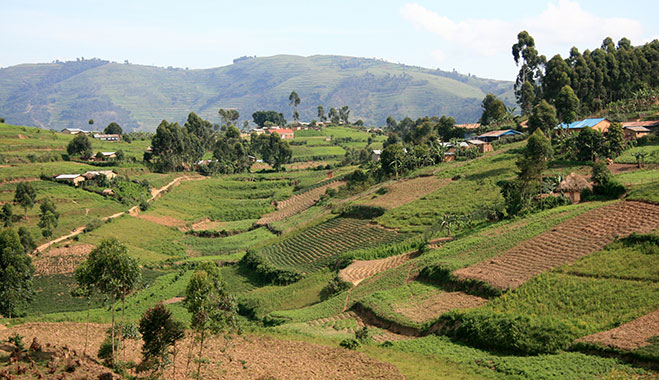
Lead researcher Elsa Ordway collects data to validate a remote sensing analysis of deforestation and agricultural expansion in Cameroon.
Credit: Courtesy Elsa Ordway
Next time you bite into a chocolate bar, think of Africa. The continent produces nearly 70 percent of the world's cocoa, a growing output that requires carving more than 325,000 acres of new farmland from forests every year -- a drop in the bucket of overall agricultural expansion there.
That expansion is the subject of a new Stanford study that provides the first comprehensive assessment of how international demand for commodity crops, such as cocoa, is affecting sub-Saharan Africa's tropical forests, second in size only to the Amazon. The findings, published in Environmental Research Letters, suggest reason for hope if policymakers tailor decisions regarding deforestation around the region's unique dynamics and uncertainties.
"We are starting to better understand issues related to large-scale agricultural expansion in the tropics," said lead author Elsa Ordway, a graduate student in Stanford's School of Earth, Energy & Environmental Sciences. "In Africa, we have the opportunity to take lessons learned from other regions and recommend preventive policies."
In particular, the study recommends policies that would alleviate poverty in local regions and incentivize forest conservation rather than the widespread deforestation that has accompanied agricultural expansion in other regions.
Full read https://www.sciencedaily.com/releases/2017/04/170405144428.htm

