
Lara Croft BY Sue Wolf
An international expedition says it has made further, remarkable finds at the site of the Antikythera shipwreck.
The vessel, which dates from 70-60BC, was famously first identified by Greek sponge divers more than 100 years ago.
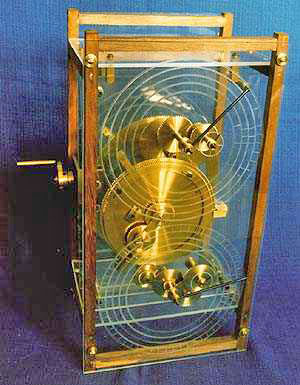
Its greatest treasure is the remains of a geared "computer" that was used to calculate the positions of astronomical objects.
The new archaeological investigations have retrieved tableware, ship components, and a giant bronze spear.
This weapon was probably attached to a warrior statue, the dive team believes.
Antikythera shipwreck
The spear probably belonged to a giant statue
Previous expeditions have found several such statues made of bronze and marble.
The new excavation efforthttp://antikythera.whoi.edu/, which ran from 15 September to 7 October, was led by the Hellenic Ephorate of Underwater Antiquities, Greece, and the Woods Hole Oceanographic Institution, US.
The wreck is in 55m of water and requires divers use rebreathers. Even so, their time on the bottom is limited to just three hours.
As a consequence, the expedition witnessed the first use of a new robotic Iron Man-like diving apparatus called the Exosuit. This enables its occupants to stay down for up to 50 hours, if necessary.
As a consequence, the expedition witnessed the first use of a new robotic Iron Man-like diving apparatus called the Exosuit. This enables its occupants to stay down for up to 50 hours, if necessary.
The team plans to return next year. It is believed many more treasures await discovery.

The spear probably belonged to a giant statue
There has been speculation that the vessel, which was probably travelling from the coast of Asia Minor to Rome when lost, was carrying a soon-to-be-married woman and her dowry.
WHOI marine archaeologist Brendan Foley recently told the BBC that he hoped to find additional parts to the Antikythera Mechanism, or other automata.

This year's expedition saw the first use of the "Iron Man" Exosuit diving system
Source:http://www.bbc.com/news/science-environment-29557384
Antikythera mechanism:
The Antikythera mechanism (/ˌæntɨkɨˈθɪərə/ ant-i-ki-theer-ə or /ˌæntɨˈkɪθərə/ ant-i-kith-ə-rə) is an ancient analog computer[1][2][3][4] designed to predict astronomical positions and eclipses. It was recovered in 1900–01 from the Antikythera wreck, a shipwreck off the Greek island of Antikythera.[5] The instrument was designed and constructed by Greek scientists and has been dated between 150 to 100 BC.[6] After the knowledge of this technology was lost at some point in antiquity, technological artifacts approaching its complexity and workmanship did not appear again until the 14th century, when mechanical astronomical clocks began to be built in Western Europe.[7]

The mechanism was housed in a wooden box about 340 × 180 × 90 mm in size and comprised 30 bronze gears (although more could have been lost). The largest gear, clearly visible in fragment A, was about 140 mm in diameter and had 223 teeth. The mechanism's remains were found as 82 separate fragments of which only seven contain any gears or significant inscriptions.[8][9]
Since their discovery the fragments of the Antikythera mechanism are kept at the National Archaeological Museum of Athenshttp://en.wikipedia.org/wiki/National_Archaeological_Museum_of_Athens.
This machine has the oldest known complex gear mechanism and is sometimes called the first known analog computer, although the quality of its manufacture suggests that it had undiscovered predecessors[18] during the Hellenistic Period.
It appears to be constructed upon theories of astronomy and mathematics developed by Greek astronomers and is estimated to have been made around 100 BC. In 1974, British science historian and Yale University professor Derek de Solla Price concluded from gear settings and inscriptions on the mechanism's faces that the mechanism was made about 87 BC and was lost only a few years later.[5] Jacques Cousteau visited the wreck in 1978[19] and recovered new dating evidence. It is believed the mechanism was made of a low-tin bronze alloy (95% copper, 5% tin), but the device's advanced state of corrosion has made it impossible to perform an accurate compositional analysis.[20] All of the mechanism's instructions are written in Koine Greek, and the consensus among scholars is that the mechanism was made in the Greek-speaking world.
Recent findings of The Antikythera Mechanism Research Project suggest the concept for the mechanism originated in the colonies of Corinth, since some of the astronomical calculations seem to indicate observations that can be made only in the Corinth area of ancient Greece. Syracuse was a colony of Corinth and the home of Archimedes, which might imply a connection with the school of Archimedes.[21] Another theory states that coins found by Jacques Cousteau in the 1970s at the wreck site and dated to the time of the construction of the device, suggest that its origin may have been from the ancient Greek city of Pergamon.[22] Pergamon was also the site of the famous Library of Pergamum which housed many scrolls of art and science. The Library of Pergamum was second in importance to the Library of Alexandria during the Hellenistic period.
The ship carrying the device also contained vases that were in the Rhodian style. One hypothesis is that the device was constructed at an academy founded by the Stoic philosopher Posidonius on the Greek island of Rhodes, which at the time was known as a center of astronomy and mechanical engineering; this hypothesis further suggests that the mechanism may have been designed by the astronomer Hipparchus, since it contains a lunar mechanism which uses Hipparchus's theory for the motion of the Moon. Hipparchus was thought to have worked from about 140 BC to 120 BC. Rhodes was a trading port at that time.
The mechanism was discovered in a shipwreck off Point Glyphadia on the Greek island of Antikythera. The wreck was found in April 1900 by a group of Greek sponge divers. They retrieved numerous artifacts, including bronze and marble statues, pottery, unique glassware, jewelry, coins, and the mechanism itself, which were transferred to the National Museum of Archaeology in Athens for storage and analysis. The mechanism itself went unnoticed for two years: it was a lump of corroded bronze and wood and the museum staff had many other pieces with which to busy themselves.[7] On 17 May 1902, archaeologist Valerios Stais was examining the finds and noticed that one of the pieces of rock had a gear wheel embedded in it. Stais initially believed it was an astronomical clock, but most scholars considered the device to be prochronistic, too complex to have been constructed during the same period as the other pieces that had been discovered. Investigations into the object were soon dropped until Derek J. de Solla Price became interested in it in 1951.[23] In 1971, both Price and a Greek nuclear physicist named Charalampos Karakalos made X-ray and gamma-ray images of the 82 fragments.
Price published an extensive 70-page paper on their findings in 1974.[7] It is not known how it came to be on the cargo ship, but it has been suggested that it was being taken to Rome, together with other treasure looted from the island, to support a triumphal parade being staged by Julius Caesar.
Source:http://en.wikipedia.org/wiki/Antikythera_mechanism


[color=#FF0000]More read here:[/color]http://www.livescience.com/1166-scientists-unravel-mystery-ancient-greek-machine.html