
These now-extinct humans lived as far back as 200,000 years ago.
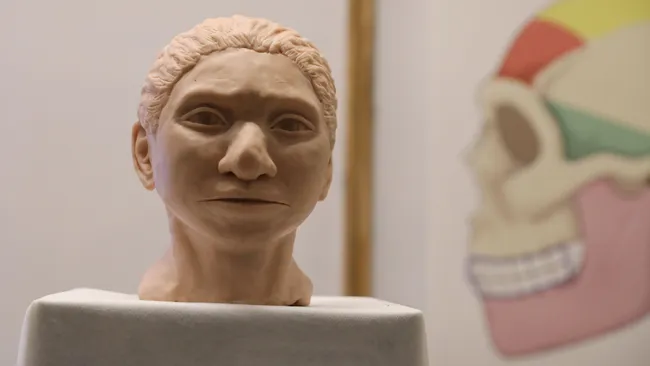
The artistic rendering of the head and face of a 13-year-old girl from the prehistoric human species, the Denisovans, based on technology developed by Hebrew University professor Liran Carmel and his team. The bust was revealed at a news conference in Jerusalem on Sept. 19, 2019. (Image credit: REUTERS via Alamy Stock Photo)
The Denisovans, together with the Neanderthals, are the closest extinct relatives of modern humans. It wasn't until 2010 that scientists announced that the Denisovans existed, so much about them remains unknown. However, fossil and genetic evidence suggests the Denisovans lived across a wide range of areas and conditions, from the cold mountains of Siberia and Tibet to the jungles of Southeast Asia.
Russian scientists excavated the first fossils linked with the Denisovans (deh-NEESE'-so-vans) in the summer of 2008, in a site known as Denisova Cave in the Altai Mountains in southern Siberia, according to the journal Nature. The cave was used as recently as the 1700s by a hermit named Denis, which is where it got its modern name — "the cave of Denis" in Russian, according to the Leakey Foundation.
Previous excavations at Denisova Cave discovered stone artifacts that decades of prior work suggested were Neanderthal in origin, according to Nature. As such, when scientists first unearthed the Denisovan fossils, they thought the remains belonged to Neanderthals.
DENISOVANS' DISCOVERY
Russian scientists excavated the first fossils linked with the Denisovans (deh-NEESE'-so-vans) in the summer of 2008, in a site known as Denisova Cave in the Altai Mountains in southern Siberia, according to the journal Nature. The cave was used as recently as the 1700s by a hermit named Denis, which is where it got its modern name — "the cave of Denis" in Russian, according to the Leakey Foundation.
Previous excavations at Denisova Cave discovered stone artifacts that decades of prior work suggested were Neanderthal in origin, according to Nature. As such, when scientists first unearthed the Denisovan fossils, they thought the remains belonged to Neanderthals.
However, subsequent analysis of ancient DNA extracted from these fossils revealed otherwise. In 2008, researchers sequenced the first complete genome of a Neanderthal, but a sliver of a 30,000- to 50,000-year-old finger bone from the cave belonged to a completely different, hitherto unknown human lineage. The scientists announced their discovery in a study in Nature in 2010.
"To show this from a tiny finger bone fragment was a remarkable technical achievement," Chris Stringer, a paleoanthropologist at the Natural History Museum in London, told Live Science.
DENISOVAN EVOLUTION
The 2010 Nature study that revealed the existence of the Denisovans found that they were close relatives of the Neanderthals. A subsequent 2013 study in Nature estimated that the lineage that gave rise to the Neanderthals and the Denisovans split from the ancestors of modern humans between about 550,000 and 765,000 years ago. The ancestors of the Neanderthals and the Denisovans later diverged from one another between about 381,000 and 473,000 years ago.
"Denisovans and Neanderthals are the closest relatives of modern humans," Katerina Harvati, a paleoanthropologist and director of the Institute for Archaeological Sciences at the Eberhard Karls University of Tübingen in Germany, told Live Science.
A 2018 study in the journal Cell revealed that the Denisovans were composed of multiple lineages. One was closely related to the Siberian Denisovan and has a genetic legacy found primarily in East Asians. The other was more distantly related to the Siberian Denisovan and had DNA nowadays mostly seen in Papuans and South Asians. These groups split about 283,000 years ago. Although these Denisovan lineages shared a common origin with Neanderthals, they were nearly as genetically distinct from Neanderthals as Neanderthals were from modern humans (Homo sapiens).
A subsequent 2019 study in the journal Cell revealed a third Denisovan lineage. Based on the level of genetic differences among all three Denisovan lineages, this study suggested this third lineage separated from the other two about 363,000 years ago, and was about as different from the other Denisovans as it was from the Neanderthals. DNA from this third lineage was found primarily in modern individuals who lived on or near the island of New Guinea.
"I couldn't have imagined these exciting advances even 15 years ago — the pace and extent of developments has been so fast," Stringer said.


